Some abandonments are especially painful because they happen at the moment love is needed most.
Ninhada’s story began there.
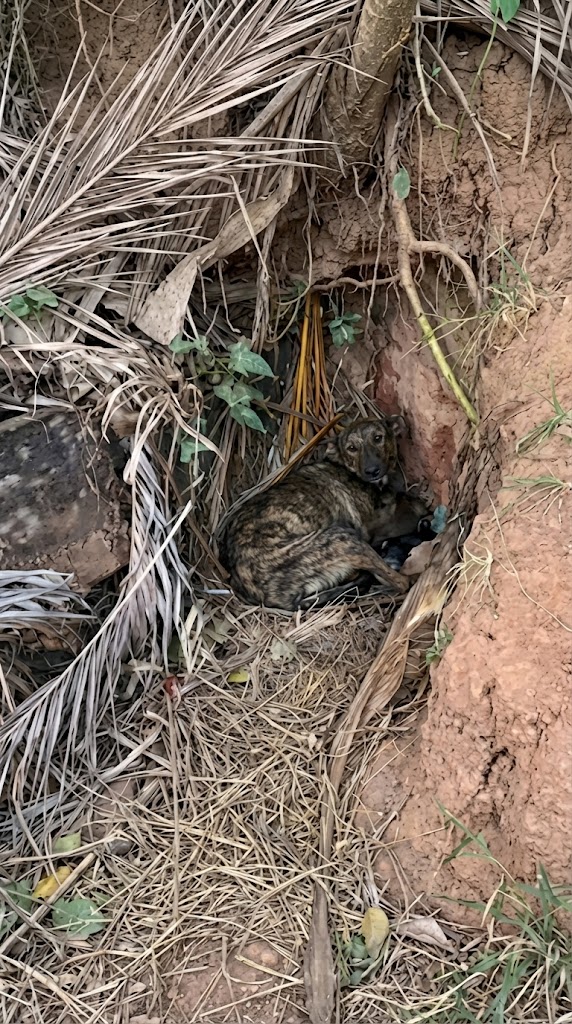
When rescuers first saw her, she was curled into a shallow hollow beneath a damaged fence, trying to make herself and her unborn puppies as small and protected as possible. The ground around her was damp and cold. Her body was painfully thin. Her ribs were easy to see. And beneath her fragile frame, her swollen belly still carried the small movements of life.
Even then, she was trying to shield them.
That image says everything about who she was. She had very little left for herself, and still, what remained was being spent on the tiny lives inside her. Not long before, she had believed she belonged somewhere. She had trusted the place she lived and the people connected to it.
Then pregnancy changed everything.
The moment it became clear she was carrying puppies, she was no longer treated as a companion. She became a problem to be removed. The gate was opened, and she was sent away—pregnant, confused, and suddenly left to face the world alone.
She had no home to return to.
No safe corner waiting for her.
No one choosing responsibility when it mattered most.
So she walked.
For days, she searched for somewhere quiet enough to lie down, somewhere hidden enough to give birth in peace, somewhere that might keep her babies alive. Hunger must have followed every step. Exhaustion must have pressed heavily against her body. But she kept going—not for comfort, not for herself, but for the small hearts depending on her.
Eventually, behind an abandoned structure, she found a patch of dirt hidden from view.
It was not shelter in any true sense.
It was only a place the world might not notice.
And there, under open sky and with no one beside her, Ninhada gave birth.
Four tiny puppies.
No blankets.
No warmth except her own body.
No helping hands.
Only a mother already weakened by neglect, trying to do everything on instinct and love alone.
She cleaned them carefully. She curled around them tightly. She did what mothers do, even when their own bodies are failing. But the truth of her condition was impossible to escape. She was starving. Her milk was scarce. Her strength was fading.
And still, she did not leave them.
VIDEO: She Was Cast Out While Pregnant — But Ninhada Refused to Let Go of Her Puppies
By the time rescuers found her, she had already reached a point where time mattered urgently. Yet even then, she did not rush toward help. She gave a soft warning growl, not out of aggression, but out of fear. To a mother in her position, strangers did not automatically mean safety. They could just as easily mean losing the only thing she had fought to keep alive.
So the people trying to help her understood what was needed first:
Patience.
They sat nearby.
They spoke quietly.
They placed food within reach.
They did not force closeness. They did not test her trust by rushing in. They gave her the dignity of deciding whether these new hands belonged to danger or care.
And then, slowly, something extraordinary happened.
She stood.
And one by one, she allowed them to lift her puppies.
That moment holds so much emotional weight. She was still watching closely. Her eyes followed every movement. She was still worried. Still mothering. But some part of her had recognized what her exhausted body may already have known: she could not do this alone anymore.
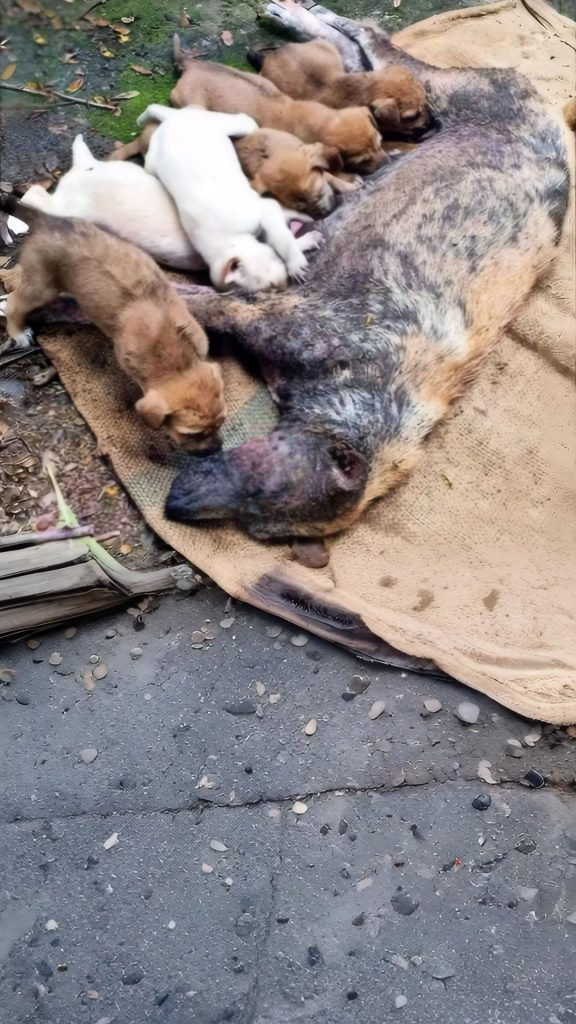
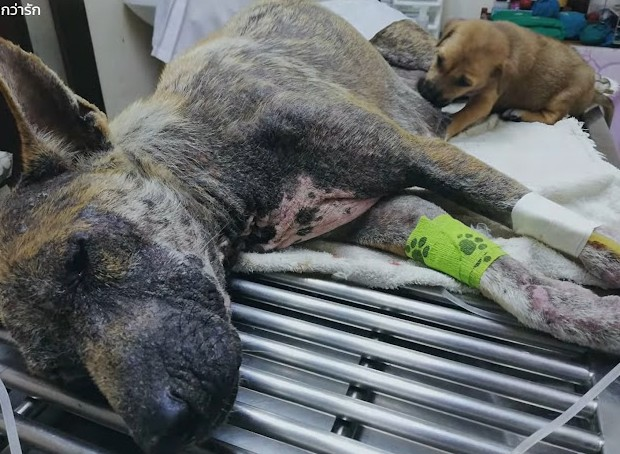
At the clinic, the seriousness of her condition became clearer. She was severely underweight, exhausted, and already battling infection. Her body was dangerously strained, and even her heart was under pressure. The puppies, tiny as they were, had survived—but their future was bound tightly to whether Ninhada could be stabilized and given the care she had gone without for far too long.
The first days were fragile.
Ninhada barely touched her food. She watched everything. Every voice. Every movement. Every sound. Her body was safe inside the clinic, but emotionally she was still living in vigilance, still carrying the fear that help might vanish or come at a cost.
The people around her did not demand trust before she was ready. They stayed close without pressuring her. They cared for her puppies. They made room for her fear while continuing to offer gentleness anyway.
And slowly, that gentleness began to reach her.
A small tail twitch.
Then, later, a slight wag.
Moments like that may seem tiny from the outside, but in stories like Ninhada’s, they mean everything. They mean a mother who has only known rejection is beginning to believe that not all hands take. Some hands stay. Some hands protect.
As the weeks passed, the little family changed together. Ninhada began eating more consistently. Her eyes softened. Her body started responding to rest and nourishment. Meanwhile, the puppies grew stronger, louder, more playful—exactly as puppies should when hunger and danger are no longer the center of every day.
Then came one of the most beautiful turning points of all.
A rescuer rolled a small ball toward Ninhada.
And she tapped it back.
It was such a simple thing.
A tiny gesture.
Almost nothing.
And yet, for everyone who had watched her survive on fear and maternal instinct alone, it meant more than words could hold. Because in that moment, Ninhada was not only enduring life.
She was participating in it.
She was playing.
That may be one of the clearest signs of healing a dog can give. It says the body is beginning to relax. The mind is beginning to imagine joy. The future no longer feels like something to survive hour by hour.
By the time her puppies were old enough to leave for homes of their own, Ninhada had changed so deeply that she hardly resembled the dog found beneath the fence. Her fur had grown healthier. Her body had filled out. Her eyes no longer searched every corner for danger.
The puppies each went on to loving families.
And Ninhada, at last, did not have to be uprooted again.
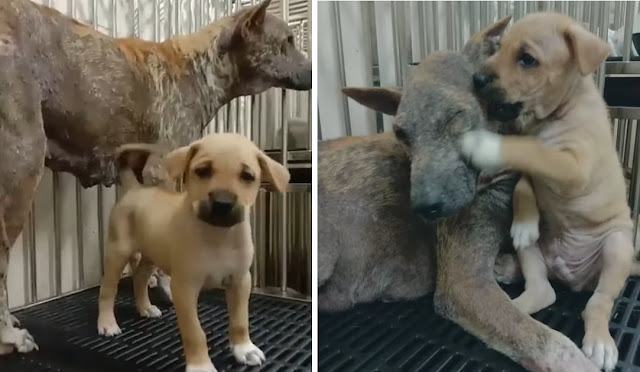
She stayed with the rescuer who had never stopped choosing her.
Today, she sleeps on soft beds. She eats without fear. She wakes in a place where she is not tolerated, not pitied, but truly wanted. The dog once cast out at her most vulnerable now lives with the safety she should have known from the start.
That is what makes her story so powerful.
Not only that she survived.
But that the part of her capable of love, trust, and gentleness survived too.
Ninhada was once thrown away when she needed kindness most.
Now, she is treasured.
And sometimes, that is the clearest picture of what rescue really means.