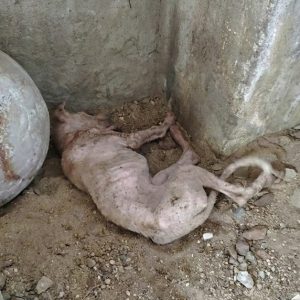
Not every life begins with safety.
Some begin with endurance.
Quiet endurance. Hidden endurance. The kind that stretches across years so long they begin to feel like a life sentence.
That was Youngji’s story.
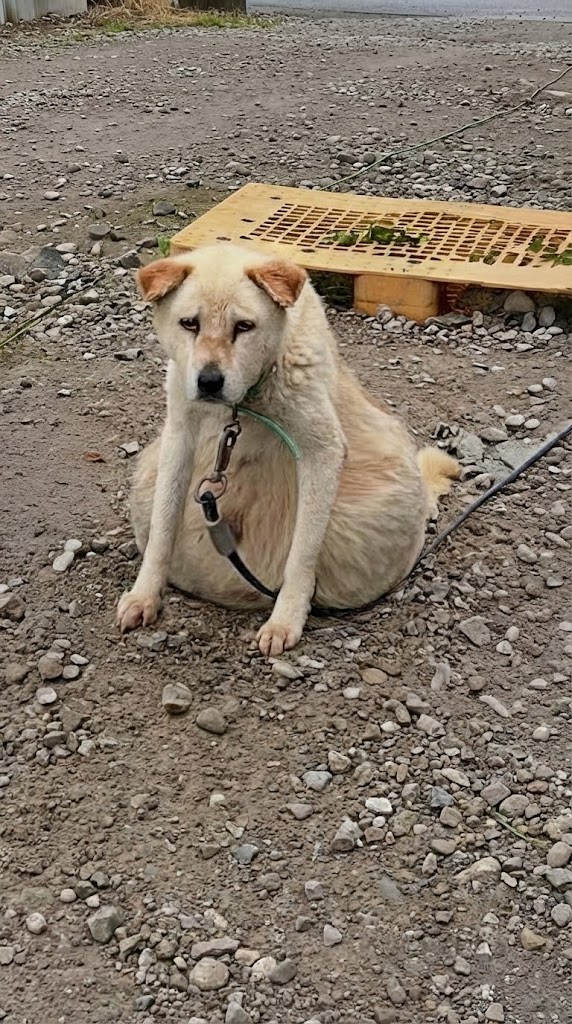
When rescuers first saw her, it was immediately clear that simply moving had become difficult. Standing took effort. Sitting seemed painful. Her abdomen was swollen, her legs were weak, and even her breathing looked measured — slow and careful, as though she had learned to conserve every small comfort her body could still hold onto.
And yet, when she noticed people nearby, something deeply unexpected happened.
Her tail moved.
Only a little.
A slow, hesitant motion.
But it meant everything.
Because that tiny wag revealed something no years of neglect had managed to take from her completely:
She still believed kindness might exist.
VIDEO: Sixteen Years in Silence — Youngji’s Long Wait for Gentle Hands
For sixteen years, Youngji had lived chained outside.
Not for a few months.
Not for a season.
For sixteen full years.
The chain remained.
Only the weather changed.
Summer heat burned her.
Winter cold settled into her bones.
Rain soaked her.
Snow passed over her.
And still, she remained tied to the same place, with no real shelter, no true comfort, and no freedom to move beyond the small space allowed by metal.
Morning after morning came and went.
Night after night passed in exposure and silence.
Nothing changed for her.
When rescuers questioned her owner, the answer came quickly and without feeling. She was old, he said. She had already lived long enough.
As if age erased suffering.
As if years of pain somehow mattered less simply because they had lasted too long.
But the dog standing there was not a burden.
She was a life that had waited far too long for dignity.
The rescue team had prepared themselves for fear.
Maybe aggression.
Maybe resistance shaped by years of neglect.
Instead, they met calm.
Youngji did not pull away.
She did not growl.
She simply looked at them with steady, soft eyes, as if some part of her understood that this moment was different.
Then her tail moved again.
Not with excitement.
Not with panic.
But with recognition.
And in that small motion, something changed in the air around her.
After long discussion, her owner agreed to surrender her.
And just like that, sixteen years of confinement quietly came to an end.
At the veterinary clinic, the full cost of those years became clearer.
Her body was fragile.
Her strength was limited.
Her health had been worn down by time, exposure and long neglect.
There was no dramatic shortcut ahead.
No miracle treatment that would erase what had been done to her.
Her healing would have to be slow.
But for the first time, it would also be gentle.
She was placed on warm bedding.
She was handled with care.
She was supported with patience.
And as her body began settling into this new world, she let out deep, soft sighs — the kind that say more than words ever could.
They were not only sounds of exhaustion.
They were sounds of relief.
For the first time in years, she no longer had to brace herself against discomfort every second of the day.
One of the most heartbreaking details of Youngji’s early recovery was this:
She did not understand softness.
When she was given a bed, she chose the floor.
When blankets were placed beneath her, she hesitated.
Comfort felt unfamiliar to her.
Not unwanted.
Just unfamiliar.
She had lived without it for so long that her body did not know what to do with it.
But slowly, she began to learn.
A warm place to rest.
Soft food offered patiently.
A gentle hand touching her head without causing harm.
Each of those small kindnesses helped her body loosen.
And once her body began to believe in comfort, her heart slowly followed.
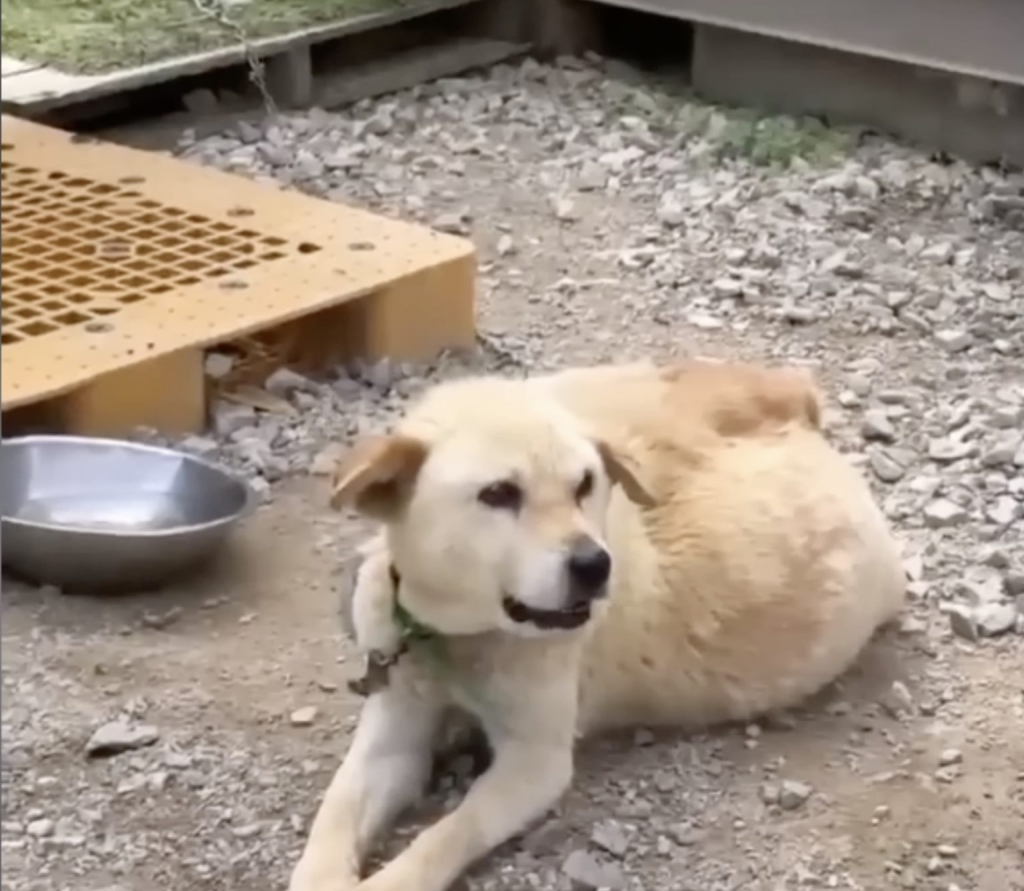
Her caregivers spoke to her with tenderness. They called her sweet girl. They called her brave soul. And again and again, her answer was the same:
A quiet, steady wag of her tail.
Youngji’s story did not remain only her own.
As people heard about her life, many began reflecting on the animals around them. Some removed chains from dogs who had spent years outside. Others reached out to rescues or offered help to older animals so often overlooked. In that way, Youngji became more than a rescued dog.
She became a reminder.
A turning point.
A reason for others to look again.
As the weeks passed, the changes in her were gentle but unmistakable.
Her breathing softened.
Her eyes became calmer.
She began leaning into familiar hands instead of simply enduring them.
Trust, once buried under sixteen years of neglect, started rising back to the surface.
Her future may still be uncertain in some ways.
But one truth is no longer uncertain at all:
Youngji will never be alone again.
Every day she has left will be lived with care.

With warmth.
With dignity.
With respect.
And perhaps that is what makes her story so powerful.
When people look at Youngji now, they do not see only the dog who lost sixteen years to a chain.
They see a gentle soul finally allowed to rest.
A life no longer defined by bondage, but by compassion.
Youngji reminds us of something we should never forget:
Love does not arrive too late simply because suffering lasted too long.
Even after sixteen years of silence, one act of kindness can still change everything.