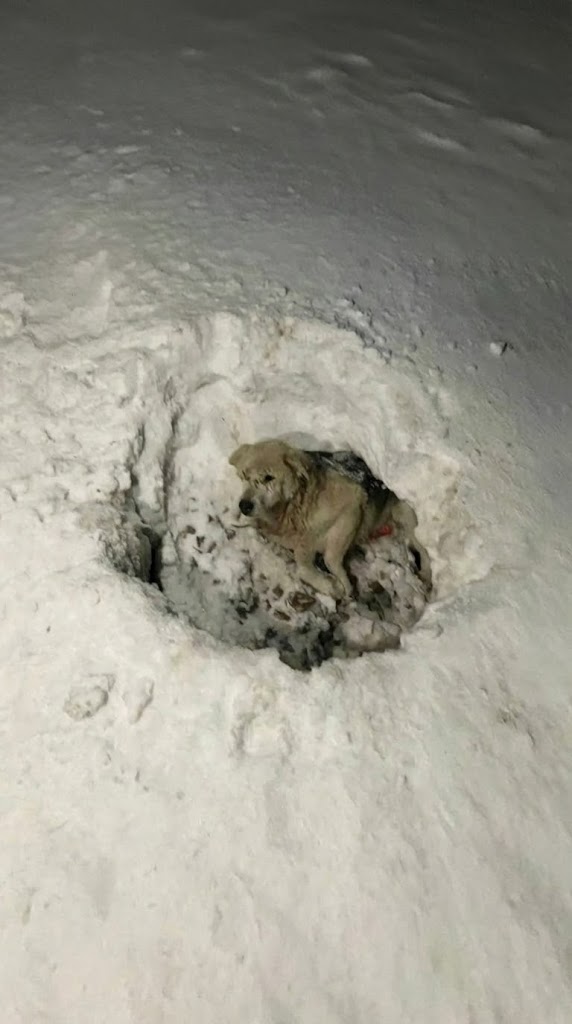
When Mishka was first found, winter had almost hidden him completely.
He lay still in a thin bed of snow, his gray coat fading into the frozen ground around him. At first glance, he barely looked alive. Only the faint rise and fall of his chest revealed that he was still holding on.
There was no struggle.
No cry for help.
Only the quiet presence of an old dog whose body seemed to have carried too much for too long.
He looked as though he had simply stopped.
As though the cold had asked for the last of his strength—and he had nothing left to give.
But that silent moment in the snow was not the end of Mishka’s story.
It was where his new life began.
A Body Worn Down by Years of Pain
Mishka was an elderly dog, and his face carried the kind of weariness that cannot be explained by one difficult day alone. When rescuers gently lifted him from the cold and brought him to safety, they noticed something deeply concerning.
His back legs did not respond.
No matter how carefully they adjusted him, there was no movement. He remained calm and still, as though he had already grown used to living this way.
At the veterinary clinic, the reason became painfully clear.
An old bullet was lodged in his spine.
It had likely been there for a long time, slowly taking away his mobility and leaving him partially paralyzed. In that moment, his stillness made sense. So did his silence. Mishka had not given up all at once.
He had been enduring this quietly for far longer than anyone knew.
For many senior dogs, an injury like this might have marked the end of hope. But the people around Mishka chose to see more than the damage.
They saw the dog who was still there.
VIDEO: He Lay Motionless in the Snow With a Bullet in His Spine — Then Mishka Found a Reason to Live Again
Seeing the Gentle Soul Behind the Injury
From the beginning, Mishka’s nature spoke for itself.
He did not react with anger.
He did not resist.
He did not turn away from the people trying to help him.
Even in pain, he remained gentle.
His eyes followed the people around him with a quiet softness, as if some part of him still wanted to believe that kindness could be real. That trust, despite everything he had lived through, was what stayed with his caregivers most.
At first, Mishka remained emotionally withdrawn.
Being unable to stand had taken more than movement from him. It had affected the way he met the world. There were moments when he seemed distant, as though he no longer expected much from life.
So nothing was rushed.
He was given routine instead of uncertainty.
Familiar voices instead of silence.
Gentle care instead of fear.
And over time, he began to respond.
Not dramatically.
Not all at once.
But in the quiet, steady way that true healing often begins.
Learning to Move Toward Life Again
Physical therapy became an important part of Mishka’s recovery.
Each session was built around patience and comfort. His legs were guided through gentle stretches. Warmth helped ease the stiffness in his body. Careful massage supported muscles that had been inactive for too long.
No one asked him for more than he could give.
And still, progress came.
A small twitch.
A brief shift in balance.
A subtle change in posture.
Each one mattered.
Each one meant that Mishka was still engaged in the work of living.
The changes were not dramatic to an outside eye, but to the people walking beside him, they were deeply meaningful. They were signs that his body and spirit were beginning to respond to care.
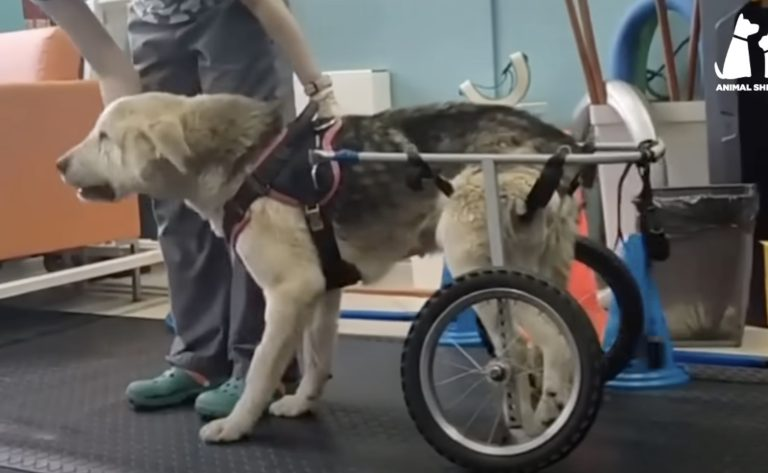
In time, the team introduced a custom wheelchair made especially for him.
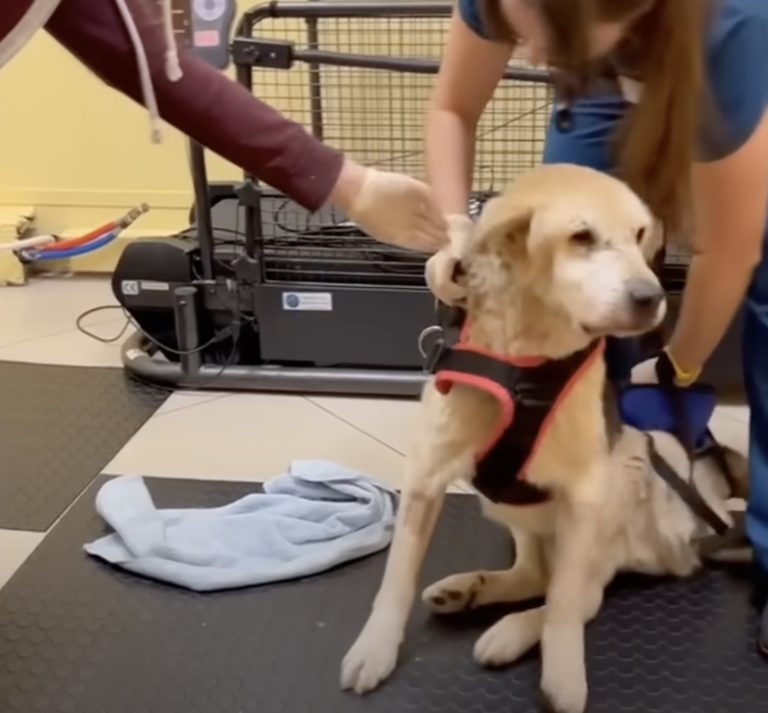
At first, it was unfamiliar. After so long without mobility, being upright again seemed uncertain. Even overwhelming. But Mishka was never forced. He was given time to understand this new support in his own way.
Slowly, he did.
And once he did, everything began to change.
Freedom in a Different Form
The wheelchair did not restore the life Mishka had before.
It gave him a new way to live the life still in front of him.
With encouragement and practice, he began to move through the world with growing confidence. What began as hesitant motion gradually became smoother and more certain. The dog once frozen in the snow started exploring again on his own terms.
His tail wagged more often.
His eyes grew brighter.
The heaviness he once carried began to lift.
What had first appeared to be a limitation became something else entirely.
Freedom.
Not in the form people usually imagine—but real freedom all the same.
The wheelchair no longer represented loss. It became part of his independence, allowing him to move, explore, and participate in life again.
A Life Given Back Its Meaning
Mishka’s story is not about becoming young again.
It is not about erasing the past.
It is about dignity being restored to a life that had known too much pain. It is about what becomes possible when someone chooses not to look away simply because a dog is older, injured, or difficult to save.
Today, Mishka greets the day with quiet enthusiasm.
He moves confidently with his wheels.
He enjoys companionship.
He rests in safety and peace.
His life is no longer centered around suffering. Instead, it is shaped by trust, routine, comfort, and the kind of care every living being deserves.
What makes his journey so powerful is not speed.
It is steadiness.
Mishka reminds us that healing does not always mean returning to what was lost. Sometimes it means discovering that life can still hold comfort, purpose, and even joy in a new form.
He was once left lying silently in the snow, his body burdened by an old wound no one had treated.
Now, he moves forward with support, dignity, and a future that finally feels gentle.
And his story leaves behind a truth worth remembering:
Hope is not always loud.
Sometimes, it arrives quietly—when someone chooses not to give up.