Not every cry for help is loud.
Some are silent.
They appear in the stillness of a body that has stopped fighting the cold… in eyes that remain open long after the strength to stand has faded.
That was the silence Max carried.
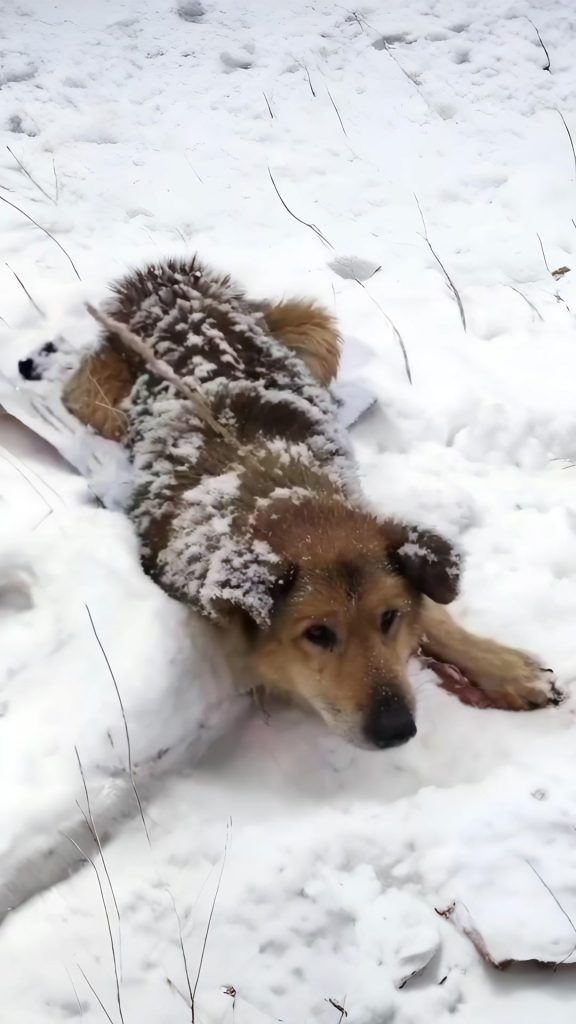
On a bitter winter afternoon, he was found lying alone in the snow.
His thin body rested against the frozen ground, completely still, as if even the thought of standing had already slipped away. People walked nearby, wrapped in warm coats and busy thoughts, unaware that a fragile life lay only a few steps away.
Max didn’t move when footsteps passed.
He didn’t bark.
He didn’t try to run.
He simply stayed where he was.
Scratches marked his fragile skin—signs of struggles he had never chosen. Hunger had left him painfully thin, little more than bone beneath tangled fur. The cold had drained what little energy remained.
Yet his eyes stayed open.
Not pleading.
Not frightened.
Just waiting.
No one knew how long he had been lying there.
Only that he had been alone.
Until one woman finally noticed him.
At first, she thought he might be sleeping. But something felt wrong. When she stepped closer, Max slowly turned his eyes toward her.
There was no resistance.
No fear.
Just quiet exhaustion.
She knelt beside him and gently reached out her hand.
Max didn’t flinch.
He allowed her touch.
And in that small, silent moment, everything began to change.
VIDEO: The Moment a Freezing Dog Was Finally Lifted From the Snow and Given a Second Chance
From Frozen Ground to Gentle Care
Help arrived without panic.
Max was wrapped carefully in a warm blanket and lifted from the snow—the place where survival had slowly replaced living. During the drive to the veterinary clinic, he remained calm, his body resting quietly in the unfamiliar comfort.
The examination revealed what everyone had already feared.
Severe weight loss.
Dehydration.
Exhaustion built over many difficult days.
But there was also something hopeful.
There were no life-threatening injuries.
His body was weak, but it could heal.
And that was enough to begin.
Care started with the simplest things.
Warmth.
Fluids.
Small meals offered patiently.
At first, Max hesitated. He sniffed his food carefully, as if unsure whether it would disappear again. But hunger slowly guided him forward.
When he finished eating, he curled into himself and slept.
Deeply.
Peacefully.
Perhaps for the first time in a very long while.
Learning That Safety Can Be Real
It was then that he received his name.
Max.
At the shelter, nothing was rushed. Every day followed the same gentle rhythm. Meals arrived at the same time. Voices remained soft. Movements stayed slow and calm.
Max watched everything closely.
Little by little, he began to understand something important:
This place was different.
No one shouted.
No one chased him away.
No one ignored him.
What surprised the volunteers most was his quiet personality.
There was no aggression.
No fear-driven reactions.
Only patience.
Each day he stood a little longer. His tail began to move when familiar faces appeared. Short walks followed—slow at first, then steadier as his strength returned.
But the biggest change wasn’t physical.
It was emotional.
When Survival Slowly Turns Back Into Living
The dog who once lay motionless in the snow began seeking closeness.
He rested beside volunteers.
He leaned gently into caring hands.
Routine brought comfort. Warmth became normal.
Life was no longer something he simply endured.
It became something he could participate in again.
Weeks later, Max explored the shelter yard with calm curiosity. His posture softened. His movements became relaxed.
Snow no longer meant danger.
It was simply ground beneath his paws.
The Moment He Found His Home
One afternoon, a family visited the shelter.
Max didn’t rush toward them.
He didn’t beg for attention.
Instead, he walked quietly over and sat beside them.
Then he leaned gently against their legs.
It was such a small gesture.
But everyone understood it.
Max had made his choice.
And the family chose him too.
In his new home, Max adapted quickly. He followed his people from room to room, content just to be near them. Walks became moments of joy instead of caution.
His body grew stronger.
His coat became healthy again.
And his eyes—once dim with exhaustion—now reflected something different.
Peace.
Today, Max’s life is no longer defined by the cold afternoon when he nearly disappeared.
It is defined by what happened after someone stopped walking.
Because sometimes, saving a life doesn’t require anything extraordinary.
Sometimes it begins with something much simpler.
Noticing.
Pausing.
Choosing compassion when it would be easier to keep going.
And sometimes, that quiet decision is enough to bring warmth back from the cold.