The message came late in the afternoon.
A neighbor said there were two dogs nearby who were still alive—but only just. Her voice trembled as she tried to describe what she had seen. It was not the kind of call that leaves room for delay.
So the rescue team left immediately.
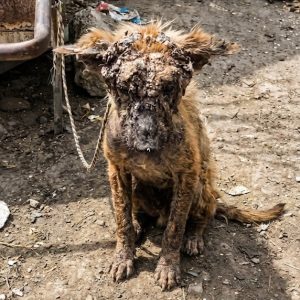
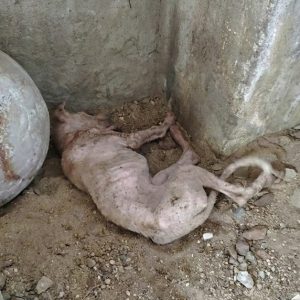
After traveling more than 100 kilometers, they saw him first: a faint white figure moving slowly along a dusty road. From a distance, he barely looked real. Thin, unsteady, and ghostlike against the earth, he seemed less like a dog than the outline of one.
This was Lynch.
He wandered close to the place that should have been home. But what waited there was not care. It was indifference.
When rescuers finally spoke with the owner, his response removed any doubt about how these dogs had been treated. He looked at them without emotion and told them to take the dogs and bring them back healthy.
As though they were damaged belongings.
As though they were not living beings at all.
A Freedom That Had to Be Paid For
Up close, the reality was even more painful than expected.
These were not dogs who had simply been overlooked for a few difficult days. Their bodies showed the effects of prolonged suffering—neglect left untreated, pain allowed to continue, wounds ignored until they became part of daily life.
It quickly became clear that the owner had no intention of truly helping them. He simply did not want the burden of what had happened.
The rescuers understood something difficult in that moment:
they were not being asked to help these dogs.
They were being asked to buy them.
When the owner named a price, it confirmed what had already become heartbreakingly obvious. He did not see Lynch and the other dog as souls in need of care. He saw them as property.
Still, the rescuers paid.
Not because they accepted that view.
But because leaving the dogs behind was not an option.
Some lives are too important to abandon over principle alone.
VIDEO: They Were Treated Like Something Disposable — Until Two Forgotten Brothers Were Finally Chosen
Two Brothers, One Shared History of Suffering
Soon after, rescuers learned the full truth.
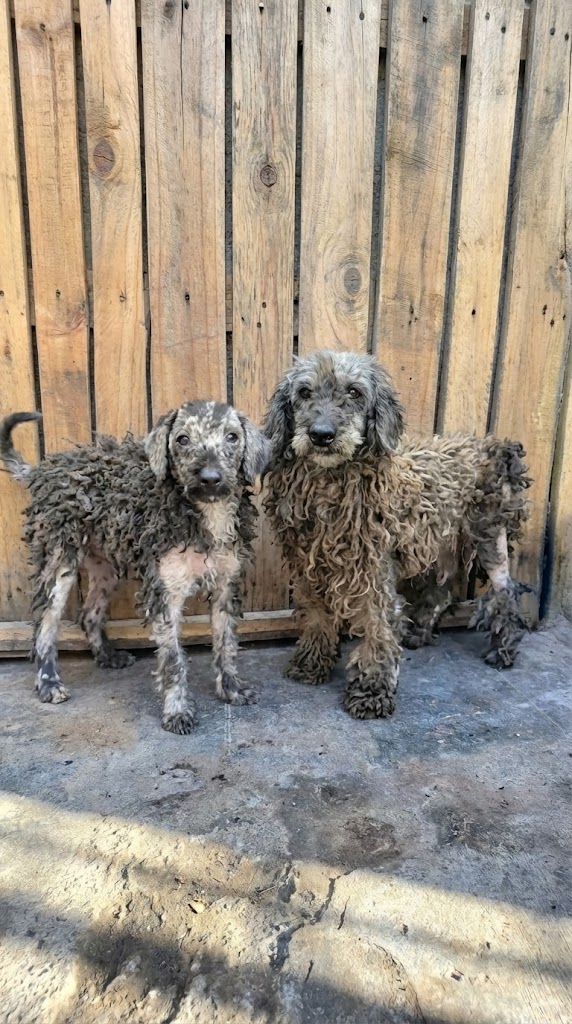
The two dogs were brothers.
Lynch, the younger one, was only about a year old. The moment someone touched him, he cried out. His small body was covered in open wounds, and thousands of ticks had attached themselves to his skin. Pain seemed to live in every part of him.
Then there was Benito.
At five years old, he had endured even longer.
His coat was not simply dirty. It had become heavily matted, hardened into thick layers that held in heat, dirt, and parasites against his body. Even walking seemed difficult. He limped heavily, each step reflecting an injury that had never been properly treated.
When rescuers asked what had happened, the answer came with chilling casualness.
The owner said Benito had been injured the year before.
No veterinary care had followed.
No relief had been offered.
No effort had been made to ease what must have been constant pain.
For an entire year, he had simply been expected to live with it.
The First Days of Care
Their recovery did not begin with anything dramatic.
It began with care.
Years of neglect were gently trimmed away. Medicated baths helped remove the dirt, parasites, and buildup that had covered their skin for far too long. As the layers came off, it felt as though part of their past was being lifted away with them.
Benito trembled through his first bath.
He did not know what was happening. Water had never meant comfort before. It had never meant relief. One rescuer held him gently and spoke in a soft voice, as if trying to explain what his body was only just beginning to learn:
the worst was over.
And slowly, that became true.
Lynch, though younger, carried his own deep burden of pain. But with each careful treatment, each medicated wash, each meal, and each moment of gentle handling, the first signs of change began to appear.
Their wounds started to close.
The constant itching began to ease.
The emptiness in their expressions softened.
Where there had once been only discomfort, something else began to appear.
Curiosity.
Then trust.
What Twenty Days Made Possible
By the twentieth day, the change felt extraordinary.
The dogs who had arrived looking broken by neglect no longer carried the same defeated stillness in their eyes. Their bodies were still healing, but their expressions had changed. They watched people differently now. They responded to care. They had begun to believe, perhaps for the first time, that gentleness could last.
Benito was also taken to a specialist.
The results brought an important measure of relief. With the right medication and support for his joints, surgery would not be necessary. His body had a real chance to recover without more invasive intervention.
That mattered deeply.
But perhaps even more moving was the change no scan could fully measure.

His spirit was returning.
The same was true for Lynch. Beneath the wounds and the weakness, he had remained open to care. And once safety became real, his whole presence began to change.
Not all healing is loud.
Sometimes, it shows itself in the way a dog no longer flinches.
Sometimes, in the way he rests.
Sometimes, in the way his eyes begin to brighten again.
The Bond That Never Broke
It is difficult to understand how anyone could keep animals only to let them suffer this way.
But even in the darkest part of their lives, Lynch and Benito held on to something beautiful:
they held on to each other.
They stayed close.
They slept side by side.
They followed one another.
They waited together.
They were brothers in every sense of the word.
And now, they are healing in that same way—together.
Their bond remained intact through hunger, parasites, untreated pain, and neglect. It survived the kind of hardship that could have emptied everything from them. And now that they are safe, that bond has become even more meaningful.
It is no longer only about survival.

It is about comfort.
Recognition.
Belonging.
What Their Story Leaves Behind
Today, Lynch and Benito are no longer trapped in the condition they were found in.
They are receiving care.
They are recovering.
They are discovering a life that feels completely different from the one they had before.
And through it all, they still have each other.
Their story is not only about what neglect can do. It is also about what love can restore. Gentle care did not just change the way they looked. It changed the way they moved through the world. It gave relief to their bodies and something equally important back to their hearts.
Safety.
Trust.
A future.
Lynch and Benito were once treated as though their suffering did not matter.
Now, they are living proof that every life can change when someone chooses to step in and care.
And their journey leaves behind a truth worth remembering:
Love cannot erase the past.
But it can give someone back the life they were always meant to have.