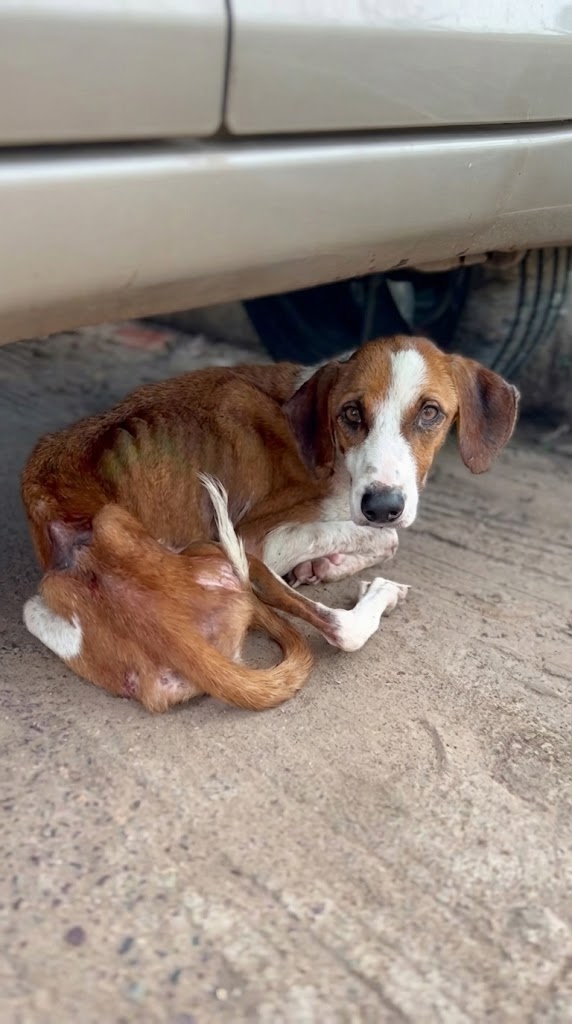
Some dogs do not cry out for help.
They hide from it.
That was how she was found—curled beneath a parked vehicle in the middle of a noisy afternoon, surrounded by movement, engines, and people too busy to look twice. Cars came and went. Footsteps passed close by. Doors opened and slammed. Life continued around her as if she were part of the pavement itself.
And perhaps, in some way, that was exactly what she wanted.
She was small.
Thin.
So quiet that it would have been easy to miss her completely.
But when rescuers finally noticed her, what stayed with them most was not only how fragile she looked. It was how still she was. She did not bark. She did not run. She did not rush toward kindness the way some desperate dogs do.
She only watched.
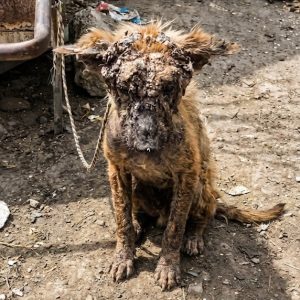
Everything about her suggested a life shaped by caution. Her fur was dusty and matted. Her body looked weakened by too little food and too much uncertainty. Every movement she made was slow, deliberate, careful—as if experience had already taught her that being seen too quickly could lead to harm.
So when people first knelt nearby, she did not come out.
She waited.
And in that waiting, there was a question larger than fear:
What will you do with me if I let you close?
That question changed the entire pace of her rescue.
The people trying to help her understood something essential right away: trust could not be forced. So they did not drag her out. They did not corner her. They did not turn her fear into another battle.
They sat down nearby.
They spoke softly.
They returned again and again.
Sometimes they brought food.
Sometimes they brought only their presence.
Day after day, she remained beneath the car, watching them the way frightened animals do when they are trying to decide whether hope is safe enough to approach. For her, trust was clearly not something simple or natural. It had likely been broken too many times before.
Then one afternoon, something changed.
She took one small step forward.
Only one.
And then she stopped.
It was such a tiny movement that many people might not have thought much of it. But in stories like hers, those moments matter more than anything. Because that first step is rarely just a step. It is the beginning of possibility.
The next day, she came a little closer.
Her eyes were still guarded.
Her body was still tense.
But curiosity had entered the space where fear had been ruling everything.
And often, that is where healing begins.
VIDEO: She Hid Beneath a Parked Car, Too Afraid to Ask for Help — Then Patience Changed Everything
Just as trust was starting to form, another painful complication appeared. A man arrived claiming she belonged to him and demanded money if others wanted to keep her safe. In one moment, the fragile little dog hiding from the world was reduced again to something transactional—an object to bargain over, rather than a life in need of care.
It was a sobering reminder of how vulnerable dogs like her truly are.
This time, though, she was not left alone in that vulnerability. Mall security intervened, and for the first time, someone firmly stood between her and the possibility of being taken back into uncertainty. That mattered.
Because rescue is not only about lifting a dog into safety.
Sometimes it is also about making sure safety is allowed to remain.
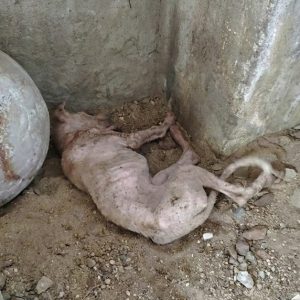
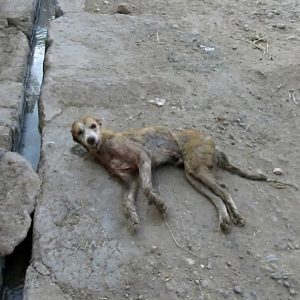
Once she reached the clinic, the truth of her condition became clearer. She was dangerously underweight. Her muscles had weakened. Her body had been surviving on almost nothing. And yet, in the middle of all that physical depletion, one thing had held on.
Her heart was still strong.
The veterinary team moved gently, understanding that dogs like her are often as sensitive emotionally as they are physically. Touch had to be careful. Sound had to stay calm. The world around her had to soften enough for her body to stop bracing against it.
And slowly, she allowed that help in.
That part of the story carries so much emotional weight. She was not a dog rushing gratefully into rescue. She was a dog learning, inch by inch, that rescue might be real. That there might be hands in the world that did not take, hurt, or demand.
The first peaceful nights mattered more than anyone could fully explain.
There was no need to remain alert under metal and concrete.
No need to vanish into shadows.
No need to compete for food or water.
Meals arrived without struggle.
Water stayed available.
A warm bed waited.
For the first time, she could rest without having to earn the right to survive.
From there, the physical changes began to show. Her fur softened. Her eyes brightened. Her body grew steadier. But as with so many rescue stories, the deepest transformation was not only visible in her body.
It was in the way she started reaching back.
Not dramatically.
Not all at once.
But gently.
She leaned into soft hands.
She followed familiar voices.
She curled up where warmth was offered instead of hiding from it.
The dog who had once tucked herself beneath a parked car, hoping the world would overlook her, was beginning to understand something completely new:
Belonging.
And when the time came for her adoption, she walked into that next chapter with a quiet calm that felt deeply earned. There were no dark corners waiting for her. No need to disappear. Only a home, a routine, and the kind of safety she had once seemed too frightened even to imagine.
Today, she is no longer the silent dog in the parking lot.
She is protected.
She is loved.
She is home.
Her story is a reminder that not every animal asks for help in ways the world easily notices. Some wait in silence. Some make themselves smaller. Some hide and hope no one comes too close—until the right person comes close in the right way.
And sometimes, that is what changes everything.