It was supposed to be an ordinary walk home.
A college student was making his way through dimly lit streets, his mind still full of classes, deadlines, and whatever else follows a long day. Then he sensed something behind him. Not a sound exactly—more a feeling that he was not alone.
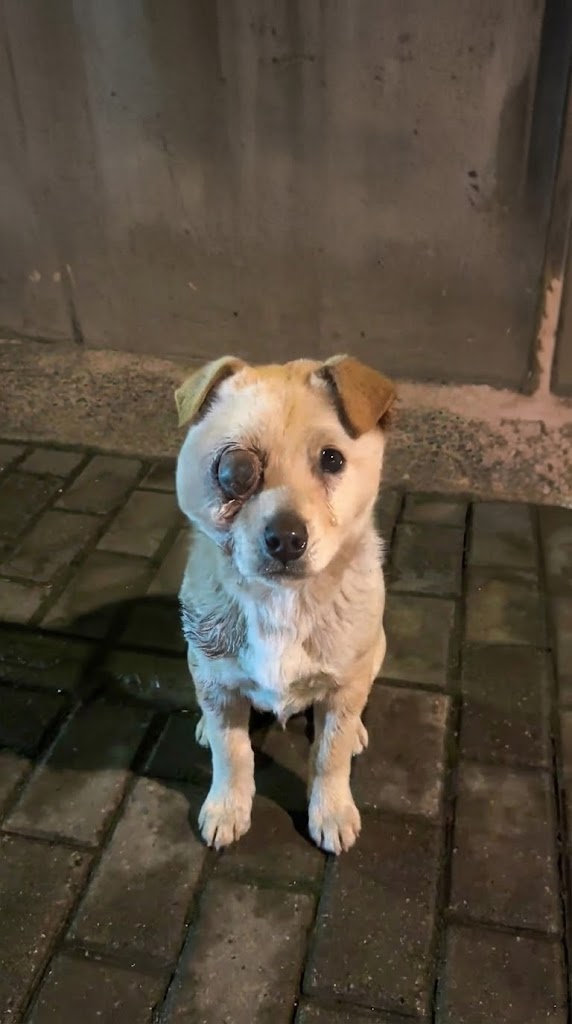
When he turned, he saw a small stray dog following him.
At first, he expected the dog to drift away the way street dogs often do. But when he slowed down, the dog slowed down too. And when he looked more closely, the full reality of what he was seeing stopped him cold.
One of the dog’s eyes was severely damaged—swollen, cloudy, and protruding in a way that made the injury look not only painful, but long neglected.
This was not a fresh wound.
This was not something minor.
This was suffering that had gone on far too long.
He Did Not Bark for Help — He Just Kept Following
The student did what many people might do at first.
He kept walking.
Not because he did not care, but because he was unprepared. He did not know what to do. He had not gone out that night expecting to become responsible for a life in distress. But every few steps, he looked back.
And every time, the dog was still there.
He did not bark.
He did not whine.
He did not beg for food.
He simply stopped when the student stopped, then sat and looked at him with his one good eye as though he were asking a quiet question no one else had answered.
Will you be the one?
That look was impossible to ignore.
At last, the student knelt down and made a decision that would change both of their lives.
“You’re not sleeping outside tonight.”
The Doorway to Safety Was Also the Start of Fear
When they reached home, the student’s cheerful puppy, Blackie, rushed forward excitedly.
But the stray dog did not move with the same ease.
He froze at the doorway.
His body tightened. He trembled where he stood. Instead of relief, there was panic in him—as though the simple reality of entering a home felt too unfamiliar to trust. Safety did not register right away as safety. It felt uncertain, overwhelming, almost impossible.
Even when fresh meat was placed in front of him, he could not eat.
That was when the student understood the situation more clearly. This was not simply a case of helping a homeless dog for one night. This was a medical emergency.
VIDEO: From a Midnight Encounter to a New Life — The Injured Stray Who Refused to Give Up
The Truth at the Hospital Was Worse Than It First Appeared
The dog was rushed to the nearest animal hospital, where the veterinary team examined him and delivered devastating news.
His injuries did not appear accidental.
They appeared deliberate.
The damaged eye was too badly compromised to save and would need to be removed immediately. It was the only way to stop the suffering and protect the rest of his health. What had begun as one student’s uneasy decision to stop and help had now become a race to save a life already marked by severe pain.
The surgery lasted hours.
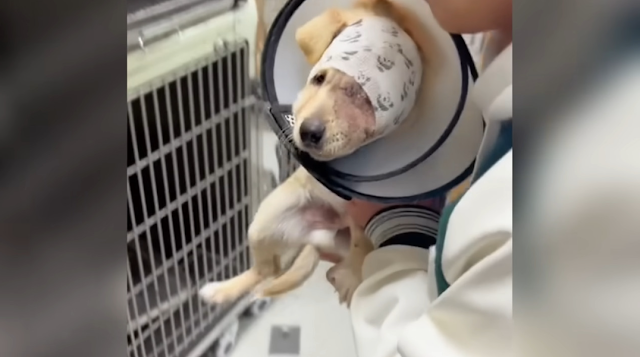
When the dog finally woke up, his face was wrapped in bandages. His jaw was stitched. His body trembled with pain, confusion, and exhaustion.
But he was alive.
And from that point on, he was no longer only a stray dog from the street.
He had a name.
Captain.
Healing Had to Be Earned Slowly
Captain’s recovery was not easy.
For days, he could not eat normally. His meals had to be soft and carefully prepared. Every afternoon, the student made special food and fed him gently by hand, helping him through a stage of recovery that required patience, routine, and far more care than a single rescue moment can ever show.
Blackie, too, became part of that healing.
He stayed close, watched carefully, and in his own way seemed to welcome Captain into the home. It is often the quietest details that make these stories so moving—not just that one animal is rescued, but that a whole household slowly bends toward helping that life feel safe.
Captain needed more than medicine.
He needed repetition.
Gentleness.
The chance to learn that no one was going to hurt him again.
And over time, he began to believe it.
The Dog Beneath the Pain Started to Appear
By the seventh day, something began to shift.
The swelling eased.
The fear softened.
The dog who had first stood frozen in the doorway started to show more of who he really was.
And what emerged was not anger.
Not bitterness.
Not defensiveness.
But gentleness.
That may have been one of the most surprising and moving parts of his recovery. After everything he appeared to have endured, Captain still had softness in him. He still leaned toward connection rather than away from it. He still seemed capable of trust.
One afternoon, he walked over to the student and pressed his head quietly against his leg.
No sound.
No drama.
Just gratitude expressed in the purest way a dog knows how.
That moment said more than words ever could.
He Was No Longer Alone
As Captain’s story spread, people in the neighborhood began to follow his recovery.
They sent messages.
They offered support.
Donations came in to help cover his medical care.
What had started with one student on one ordinary walk home became something larger: a circle of compassion forming around a dog who had spent far too long suffering alone.
That kind of support matters.
Not only because it helps pay bills, but because it changes the emotional shape of the story. Captain was no longer only surviving because one person happened to stop. He was now being carried forward by many people who had decided his life mattered.
And slowly, Captain changed with that support.
The Dog Who Once Trembled at the Door Became Someone New
After 17 days of intensive care, Captain was finally discharged.
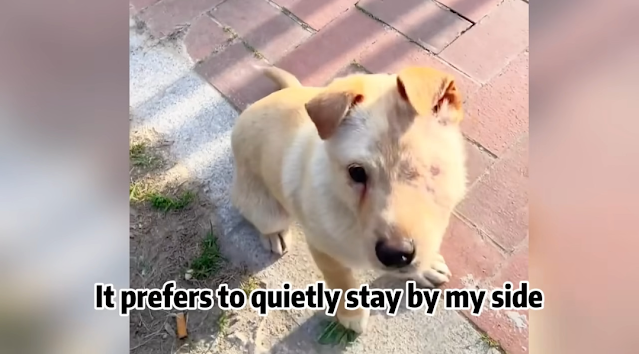
By then, the frightened creature who had stood trembling at the doorway was no longer the same dog. He entered the home with confidence. His tail lifted. His body moved with a lightness that had not been there before.
The transformation was not only physical.
It was emotional.
It was relational.
It was the slow return of joy.
Today, Captain runs freely at the park. Though he now lives with one eye, he moves through the world with the kind of confidence that makes you forget to focus on what he lost. What people notice instead is how alive he is.
How eager.
How playful.
How full of forward motion.
He no longer looks behind him.
He looks toward the next game, the next touch, the next good thing.
Why Captain’s Story Stays With You
Captain’s story is not only about survival.
It is about what happens when one person chooses to stop instead of keep walking.
It is about the quiet power of being noticed at exactly the right moment.
It is about how badly suffering can hide in plain sight.
And it is about the fact that sometimes an animal does not need a grand rescue plan at first—only one human willing to say yes to the interruption.
A dog followed a student home through the dark.
A student turned around and saw him.
And because he did, a life that might have disappeared into pain was given a completely different ending.
Somewhere, there are still other dogs like Captain—waiting in silence, hoping someone will finally understand the question in their eyes.
And sometimes, one small decision really is enough to save a soul.